Uchida’s ink painting of Sayuri
Memoirs of a GeishaUchida’s ink painting of Sayuri takes its point of origin, in the painter’s account, from a small, unposed gesture: Sayuri studying her hands in the sunset. The work matters not only as a celebrated image associated with her, but as the uncertain conversion of a private moment into an artistic subject. Sayuri never fully accepts Uchida’s explanation, and the distance between the radiant image and the dull reality of posing remains part of its story.
The Sunset Encounter
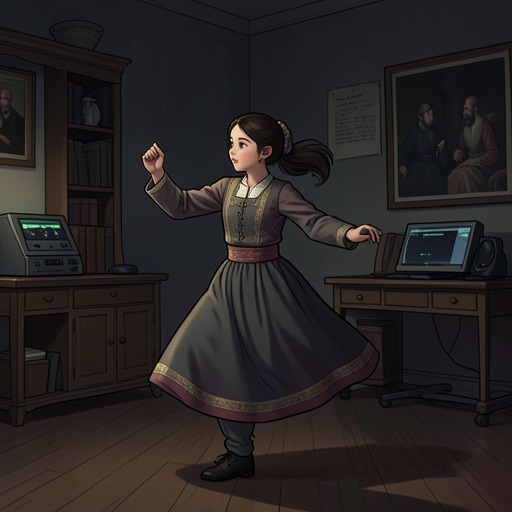
After visiting Uchida’s studio, Sayuri and Mameha rose to leave as the afternoon light faded. Outside, Sayuri stopped to watch the sunset behind the distant hills. The sky’s rust and pink hues reminded her of a beautiful kimono, but the light did something a garment could not: it made her own hands seem to glow. She raised them and gazed at them, absorbed in the sight.
Sayuri called Mameha’s attention to her hands, but Mameha thought she meant the sunset and turned toward it without interest. Uchida, standing in the entryway, had frozen with one hand combing through a tuft of his gray hair. His attention was not on the sky. He was watching Sayuri. The scene’s decisive image is therefore an accidental meeting of light, body, and gaze: Sayuri sees the sunset’s effect on herself, while the painter sees her seeing it.
From Gesture to Image
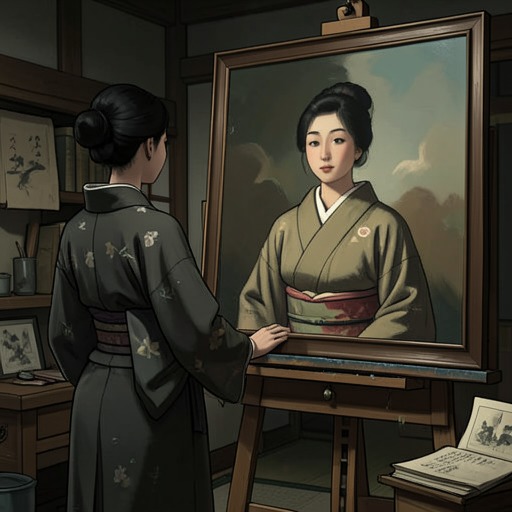
Uchida later insisted that the idea for his famous ink painting came from that afternoon. The work depicts a young woman in a kimono, rapturous and with glowing eyes, an image that preserves the quality of absorbed wonder associated with Sayuri’s gaze. His claim links the painting to her encounter with the sunset without making the finished image a literal record of the moment.
Sayuri remains skeptical of the origin story. She cannot imagine that so beautiful a painting could really have been based on a girl foolishly staring at her hands in the sunset. Her reservation leaves a productive gap between the painter’s account and the narrator’s memory: the image may draw on what Uchida saw, but its artistic force cannot be reduced to that incident. The painting’s celebrated appearance and the modest, almost self-conscious action Sayuri remembers are held together without being reconciled.
The Model and the Working Conditions
The sunset encounter belonged to a longer connection between the painter and his model. After Uchida’s cat died from an infected badger bite, he fell into another drinking spell. Mameha visited him for several days, then sent Sayuri to his studio in an ice-blue kimono embroidered with multicolored ribbons at the hem. She wore only a touch of Western-style makeup, intended to accentuate the angles of her face, and brought him a costly pearl-white kitten. Uchida paid little attention to the gift; instead, he studied Sayuri, squinting and shifting his head from side to side.
A few days later, Uchida asked Sayuri to model. Mameha instructed her not to speak and sent her under the chaperonage of her maid, Tatsumi. While Tatsumi nodded off in a drafty corner, Uchida moved Sayuri from one position to another, mixing inks frantically and painting briefly on rice paper before repositioning her. Sayuri’s silence and stillness were part of the practical arrangement, but they also made the encounter with the painter sharply unequal: he directed her body and attention while she was expected to remain quiet.
The result looked more glamorous from a distance than it felt to the person sitting for him. Sayuri recalls uncomfortable sessions lasting an hour or more, thirst, and Uchida’s refusal to offer her anything to drink. When she began bringing tea in a sealed jar, he moved it across the room so that it would not distract him. Her memory of the work resists the romance often attached to artistic creation: the image might glow, but its making involved waiting, discomfort, and an artist’s uncompromising concentration.
An Unfinished Account of Artistic Attention
One bitter afternoon in February, Uchida sat directly before Sayuri and stared into her eyes, chewing the mole at the corner of his mouth. He ground ink sticks with water that kept icing over, trying different combinations of blue and gray, but none satisfied him; repeatedly, he took the ink outside and spilled it into the snow. As he continued to scrutinize her, his anger grew, and he finally sent her away. Sayuri later learned that he had entered another drinking spell, and Mameha blamed her for allowing it to happen.
That episode gives the painting’s origin story a more difficult context. Uchida’s attention could fix on Sayuri with the intensity that produced an enduring image, but his work also depended on an uncomfortable model and could turn into frustration without explanation. The evidence does not establish that the February session produced the famous painting, nor that the sunset scene alone accounts for its composition. It instead shows a recurring process: Uchida looking, arranging, and revising, while Sayuri experiences the labor from within the pose.
The painting’s significance thus rests in the contrast between a moment of unplanned radiance and the extended discipline of being made into an image. Sayuri’s hands glow briefly in a sunset she can see for herself; Uchida’s later painting gives that kind of wonder a lasting form, but its supposed origin remains his claim rather than her conviction. Her doubt preserves the difference between the living girl in the fading light and the celebrated figure fixed on paper.